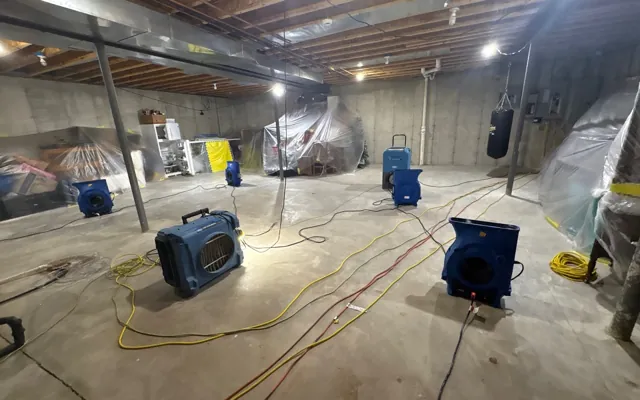
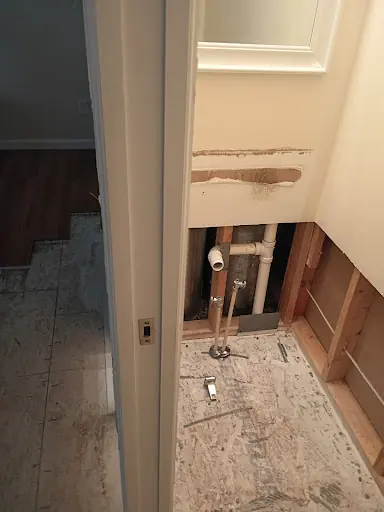
True basements are rare on Torrance's slab-on-grade lots, but the handful of older homes with a below-grade room still flood. IICRC-standard crews respond in about an hour.

Crews inspect the sunken or below-grade space, identify the water source, and check adjoining slab areas since water often travels farther than it appears.
Truck-mounted and portable pumps remove standing water quickly, with special attention to corners and drains where water pools in a below-grade room.
Dehumidifiers and air movers dry walls, subfloor, and any framing, with moisture meters tracking progress in a space that dries more slowly than an open room.
Damaged drywall, flooring, and baseboards are replaced, and crews flag any drainage improvements worth considering to reduce future risk.

While help is on the way, these first steps, done only where it is safe, limit the damage and protect the insurance claim.
Shut the supply off at the source, or close the home's main valve if the source is not obvious. Stopping the flow limits the damage more than anything else.
Switch off electricity to the affected area, but only if the breaker can be reached without standing in or touching the water.
Get a crew dispatched right away. The sooner extraction and drying begin, the more flooring, drywall, and belongings can be saved.
Take photos and a short video of the water and the affected rooms before anything is moved, so the insurance claim starts strong.
Below-grade or converted-basement flood cleanup in Torrance typically runs $1,800 to $6,000, depending on square footage, how long water sat, and whether flooring or drywall must be replaced. Because true basements are uncommon here, pricing varies more than in cities built with them. Most homeowner's policies cover sudden events like a burst pipe; crews document everything to support your claim.
Crews reach Torrance and the South Bay fast, from Old Torrance and West Torrance to Walteria, Hollywood Riviera, and nearby Redondo Beach and Carson. See the full list on the areas served across Torrance page.
See all areas servedEvery loss is photographed, measured, and logged from the first visit, so the paperwork holds up with your insurance carrier.
Technicians follow recognized IICRC drying standards and prove the work with daily moisture readings, not guesswork.
Emergency dispatch any hour of the day or night, with a real crew on the way, not a callback in the morning.
A real crew dispatched any hour, not a callback in the morning.
Trained technicians following recognized IICRC drying standards.
Truck-mounted, portable, and submersible for any size loss.
The loss is documented and billed to the carrier directly.
Almost never. The vast majority of Torrance homes are slab-on-grade, so true basements are essentially nonexistent here. What people usually mean is a below-grade laundry room, sunken garage, or an older converted cellar, and crews handle flood cleanup for all of those.
Shut off the water source if it is a plumbing failure, avoid stepping into standing water near outlets, and call right away. The longer water sits in an enclosed below-grade space, the more it soaks into flooring and drywall.
Yes, especially since these spaces often have less airflow than a typical room. Mold can start within 24 to 48 hours of standing water. Fast extraction and thorough drying with commercial dehumidifiers prevent it from taking hold.
Most homeowner's policies cover sudden damage from a burst pipe or water heater failure. Damage from gradual seepage or poor grading is less likely to be covered. Crews document the cause and moisture readings to support your claim either way.
Most below-grade Torrance rooms dry within 4 to 7 days once extraction starts, though enclosed spaces with poor ventilation can take longer. Crews track moisture levels daily and keep equipment running until readings confirm it is safe.
Torrance crews are on call 24 hours a day, local and fast, and can be on the way within the hour.
Call (424) 370-1501