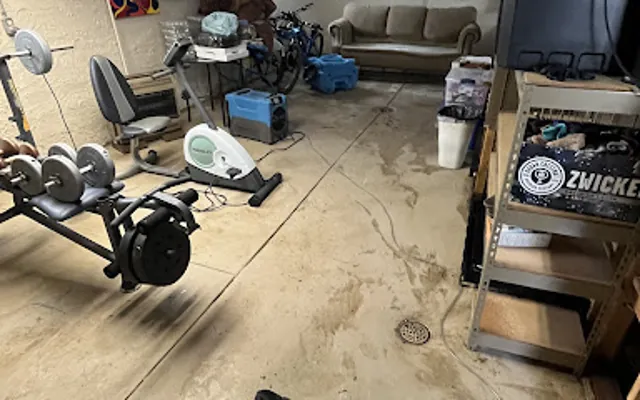
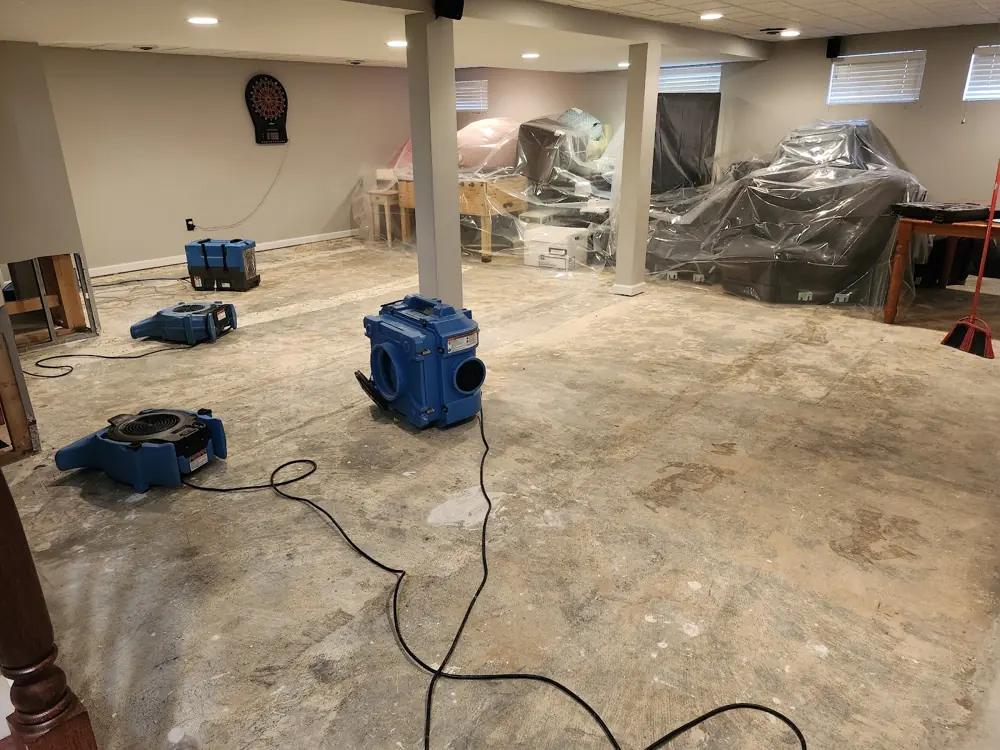
Corroded copper or galvanized pipe under a 1950s-70s Torrance slab can leak for weeks before a warm patch of flooring or a rising water bill gives it away. Crews respond in about an hour, IICRC-standard, to extract and dry before it spreads further.

Crews use moisture readings and, when needed, leak detection equipment to pinpoint roughly where the pipe under the slab has failed.
Water that has migrated up through the slab into flooring and baseboards gets extracted before drying begins.
Flooring that has trapped moisture against the slab, such as hardwood or laminate, often needs removal to allow the concrete underneath to dry.
Specialized drying targets the slab itself, not just the surface material, with moisture readings confirming the concrete is dry before crews close the job.

While help is on the way, these first steps, done only where it is safe, limit the damage and protect the insurance claim.
Shut the supply off at the source, or close the home's main valve if the source is not obvious. Stopping the flow limits the damage more than anything else.
Switch off electricity to the affected area, but only if the breaker can be reached without standing in or touching the water.
Get a crew dispatched right away. The sooner extraction and drying begin, the more flooring, drywall, and belongings can be saved.
Take photos and a short video of the water and the affected rooms before anything is moved, so the insurance claim starts strong.
Slab leak water damage cleanup in Torrance often runs from around a thousand dollars for a contained area with tile flooring, up to several thousand when hardwood or a larger area of flooring needs removal and the slab requires extended drying. Many homeowners policies cover the resulting water damage even when the pipe repair itself is excluded, so crews document everything to support that distinction.
Crews reach Torrance and the South Bay fast, from Old Torrance and West Torrance to Walteria, Hollywood Riviera, and nearby Redondo Beach and Carson. See the full list on the areas served across Torrance page.
See all areas servedEvery loss is photographed, measured, and logged from the first visit, so the paperwork holds up with your insurance carrier.
Technicians follow recognized IICRC drying standards and prove the work with daily moisture readings, not guesswork.
Emergency dispatch any hour of the day or night, with a real crew on the way, not a callback in the morning.
A real crew dispatched any hour, not a callback in the morning.
Trained technicians following recognized IICRC drying standards.
Truck-mounted, portable, and submersible for any size loss.
The loss is documented and billed to the carrier directly.
Common signs include a warm or damp spot on an otherwise cool floor, an unexplained spike in your water bill, or the sound of running water when every fixture in the house is off. A cracked or lifting section of flooring can also be a sign.
Crews handle the water extraction and structural drying, and crews can help confirm roughly where the leak is. A professional plumber handles accessing and repairing the pipe itself, whether by slab penetration or re-routing.
It depends on the material and how long the leak was active before discovery. Tile often survives with minimal disruption, while hardwood and laminate frequently need to come up so the slab underneath can dry properly.
Many homeowners policies cover the water damage caused by a slab leak even when they exclude the cost of accessing and repairing the pipe itself. Crews document the damage clearly so you can pursue that portion of your claim.
Drying a slab typically takes longer than drying a subfloor, often five to seven days depending on how saturated the concrete became and how much flooring material is covering it during the drying process.
Torrance crews are on call 24 hours a day, local and fast, and can be on the way within the hour.
Call (424) 370-1501